Introduction
What SDODS is, what it wraps, and how its pieces fit together.
What SDODS is, which problems it takes off your plate, the CLI-first principle that shapes every feature, and how the packages fit together.
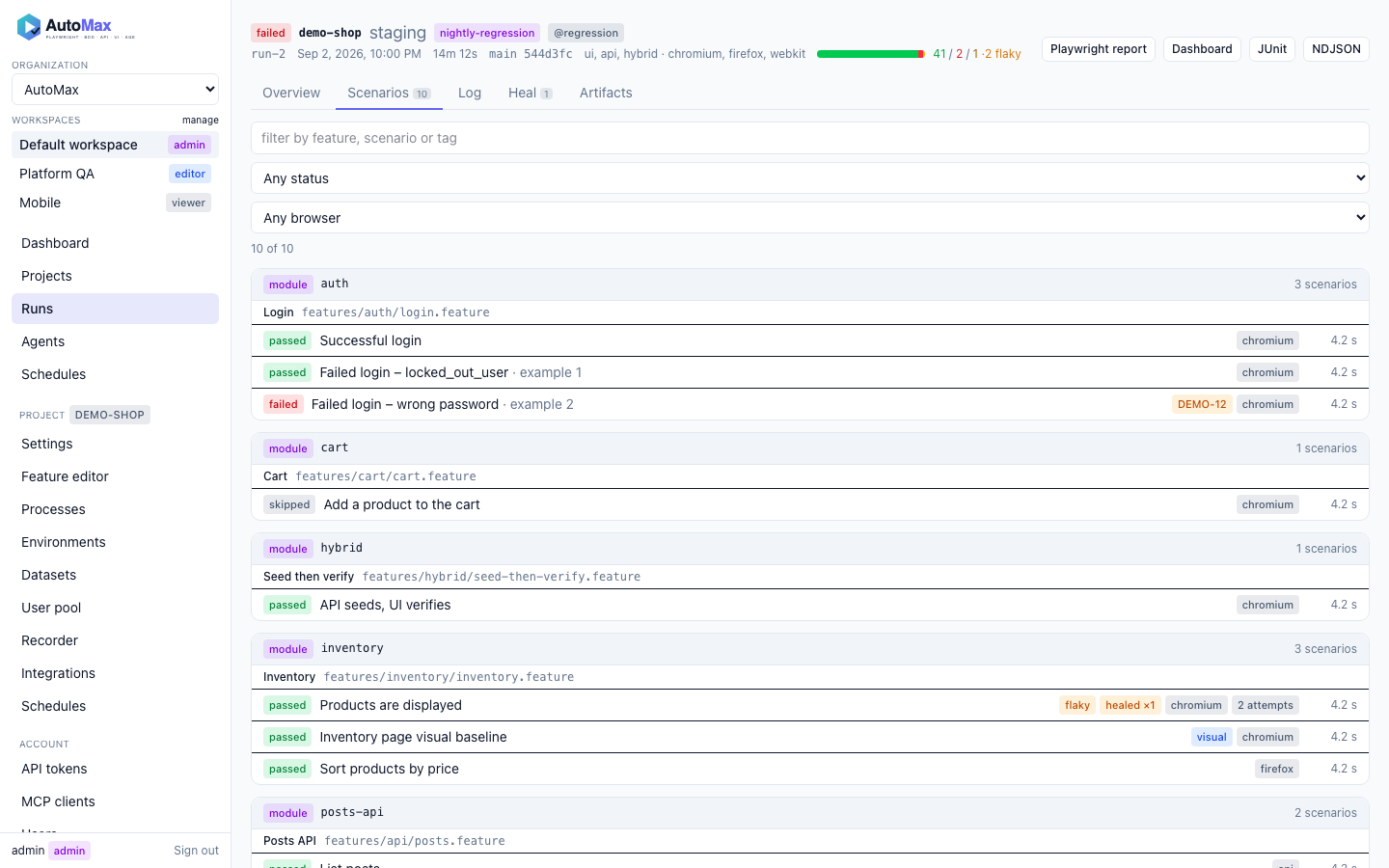
SDODS is open-source BDD test automation for UI and API that leaves evidence behind every run: before/after screenshots, the requests that produced them, and a history of every run. You write scenarios in Gherkin, keep one YAML file per project and one per environment, and drive everything from the sdods command line. The same commands power the web UI, the MCP server and the scheduler.
Using an AI coding agent? Install SDODS:
Install the SDODS plugin in Claude Code: skills, subagents, commands and the MCP server.
/plugin marketplace add YarlisAISolutions/sdods-skills/plugin install sdods@sdods
What it gives you
| Concern | A bare test runner | With SDODS |
|---|---|---|
| UI, API and hybrid scenarios | separate test files, separate fixtures | one merged fixture set; one scenario can seed through the API and assert in the browser |
| Many applications and environments | one hand-written config | projects/<slug>/sdods.project.yaml and envs/<env>.yaml, generating a run target per project × layer × browser |
| Configuration | environment variables and code | six layers with fixed precedence, validated, explainable with sdods config show --explain |
| Test data | ad hoc | CSV, JSON, YAML, database tables and factories per environment; user pools leased per worker |
| Results | HTML report | before/after screenshots per step, API snapshots, run history in SQLite or Postgres, insights |
| Resilience | none | scored self-healing locators with persisted history |
| Tooling around tests | none | MCP server, AI agents that write reviewable proposals, GitHub and Jira, cron schedules, web UI |
The CLI-first principle
Every capability is an sdods command that works with no server and no database. The web UI, the MCP server and the scheduler spawn those commands and stream their output. CI needs nothing but Node and the repository.
bun run sdods run -p demo-shop -e staging -l api
bun run sdods run -p demo-shop -e staging -l ui -b chromium -t @smoke
How it works
Packages
| Package | Owns |
|---|---|
@sdods/contracts | Zod schemas for the YAML files, identifiers, attachment names, scopes, shared types |
@sdods/core | configuration, project registry, fixtures, step library, data providers, screenshots, self-healing, recorder, lint, reporters |
@sdods/db | Kysely schema, migrations, ingest, insights |
@sdods/mcp | tool registry and MCP transports |
@sdods/integrations | GitHub and Jira providers |
@sdods/agents | LLM adapters, agent roles, proposals |
@sdods/server | REST, SSE, /mcp, authentication, scheduler |
@sdods/web | the React application |
@sdods/cli | the sdods command |
The test workers, vitest and the native database drivers run on Node 22. Bun is the package manager, script runner and bundler; pnpm works too. Nothing executes tests under Bun.
Status
All fourteen phases are implemented and verified; the roadmap walks them as five delivered chapters, with the numbers each claim rests on and the twelve months ahead. What is still open is listed on the known limitations page. SDODS is released: @sdods/cli and the other @sdods/* packages are on npm, each version has a GitHub release, and the server is published as a container image on GHCR. See Installation.