6 · Record and HAR
Record a session into a runnable spec, convert it into a reviewed proposal, and make the suite run with the application switched off.
How recording produces a spec you can run today and a feature you can review tomorrow, and how a HAR file turns a suite that needs a running application into one that does not.
Time: 20 minutes · You need: chapter 5 finished.
Record
sdods record opens a browser, watches what you do, and writes a runnable spec under
recorded/. It can start already signed in, which is what makes recording a deep page bearable:
sdods record -p rwa-bank -e local --url signin --name signin-flow
sdods record -p rwa-bank -e local --url personal --user standard --name new-payment
sdods record -p rwa-bank -e local --url signin --device "iPhone 15" --name signin-mobile
The result runs as its own layer, so a recording is useful before anyone has written a step:
sdods run -p rwa-bank -e local -l recorded --grep "signin-flow"Convert it into a feature
A recording is a transcript, not a test: it clicks coordinates and CSS chains. record convert
asks the generator agent to rewrite it as Gherkin over the existing step library, with role and
test-id locators.
sdods record convert projects/rwa-bank/recorded/signin-flow.spec.ts --dry-run
sdods record convert projects/rwa-bank/recorded/signin-flow.spec.ts
sdods proposals list
sdods proposals show <id>
sdods proposals accept <id> --branch sdods/signin-flow
Nothing is applied without you: the agent writes a proposal, and accept puts it in the working
tree or on a branch. --dry-run prints the prompt and plan without calling a model, and
--adapter ollama runs the conversion on a model on your own machine
(local models).
This is the migration path for the 33 Cypress specs the analyzer found in chapter 1: record the flow once, convert it, review the proposal. The old spec is the specification; the new one is the test.
HAR: run with the application switched off
A HAR file is a recording of the network. Tag the scenarios worth freezing, record once, and every later run can replay from disk.
  @regression @har:profile
  Scenario: A public profile exposes a name and nothing else
    When I send a GET request to "/users/profile/Heath93"
sdods har record -p rwa-bank -e local -t "@har:profile"
sdods har list -p rwa-bank -e local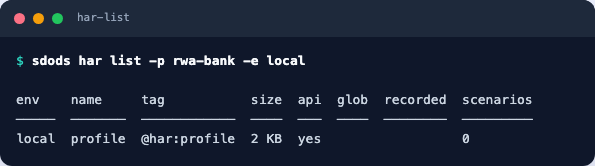
Now stop the application — actually stop it — and replay:
sdods har replay -p rwa-bank -e local -t "@har:profile" --strict--strict aborts any request that is not in the recording, so a passing strict replay proves the
suite touched nothing but the file. That is what makes HAR the answer for CI: no environment, no
seeded database, no flake from someone else's deploy.
A HAR freezes an API contract in time. When the endpoint changes, the replay keeps passing and lies to you — so re-record on a schedule, and keep at least one non-HAR run against the real application.
Checkpoint
sdods har list -p rwa-bank -e local && sdods har replay -p rwa-bank -e local -t "@har:profile" --strictThe replay passes with the application stopped. Next: visual, accessibility and performance.